The Ordinary Jackpot (2026) Episode 3 Recap & Ending Explained
The Ordinary Jackpot (2026) Episode 3 recap and ending explained. Eun-tae negotiates a major fashion deal, challenges his boss, and faces a new threat. Copy
Este artículo aún no está disponible en tu idioma, así que mostramos la versión en inglés.
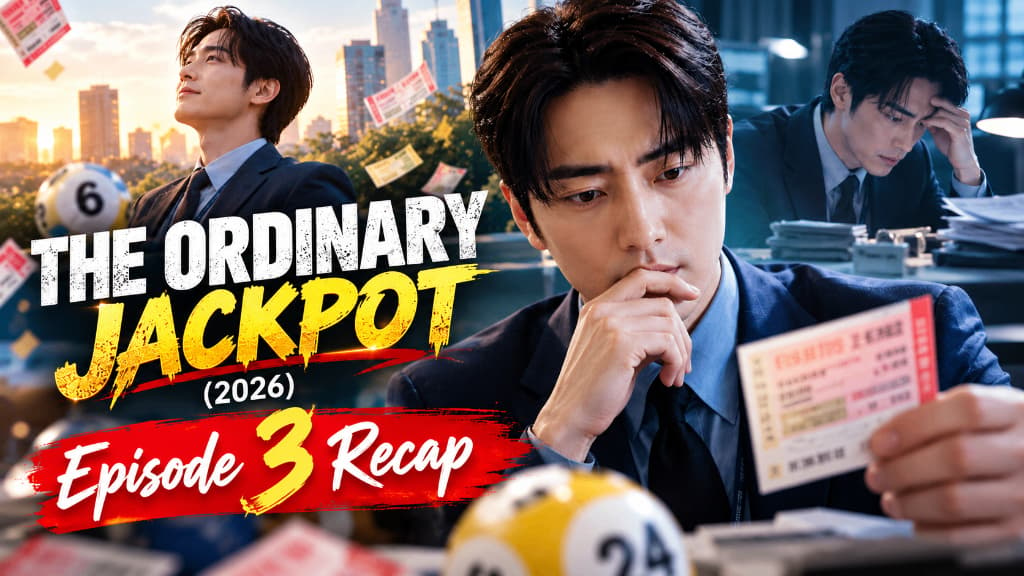
The Ordinary Jackpot (2026) Episode 3 Recap: A Bold Deal and a Dangerous New Rival
Drama: The Ordinary Jackpot (2026)
Episode: 3
Genre: Korean Drama, Workplace, Life
Spoiler Warning: This recap contains spoilers for Episode 3.
Introduction
The Ordinary Jackpot (2026) Episode 3 follows Gong Eun-tae as he begins turning his newfound confidence into meaningful changes at work.
After winning the lottery and questioning the sacrifices he has made throughout his career, Eun-tae is no longer willing to accept every decision made by his superiors.
This time, he faces an important business negotiation involving the international fashion brand Laknes. The outcome could determine his team’s future and reshape the balance of power within the company.
With Yang Jun-ho working alongside him, Eun-tae attempts to prove that his team deserves greater recognition.
But as he challenges the company’s internal politics, he also discovers that standing up for himself may create unexpected enemies.
Meanwhile, a new employee’s arrival threatens to introduce an entirely different problem.
Office Politics Threaten the Sales Teams
Episode 3 opens with tension surrounding the company’s internal staffing decisions.
Employees are being pressured to move between teams, and some are unhappy about the proposed transfers.
The situation reflects a larger struggle involving promotions, departmental influence, and control over profitable fashion brands.
Several team leaders are competing for advancement, particularly those managing Sales Teams 1 and 2.
However, their ambitions create problems for employees in other departments.
Sales Team 5 appears especially vulnerable.
While the more powerful teams compete for influence, Team 5 risks losing brands and resources without receiving meaningful benefits.
One employee compares the situation to innocent bystanders getting hurt during a fight between two powerful opponents.
The message is clear: workplace politics can damage people who have little involvement in the original conflict.
For Eun-tae, these problems make the upcoming Laknes negotiation even more important.
Preparing for the Important Laknes Meeting
Eun-tae and his colleagues prepare to meet representatives from Laknes, an international fashion brand considering expanding its Korean business.
The team carefully organizes its presentation, reviews documents, and arranges the meeting facilities.
Eun-tae understands that a successful agreement could strengthen his department’s position.
However, he also knows that simply signing the contract will not guarantee long-term success.
The company expects him to secure the deal quickly, but he wants to negotiate terms that will actually benefit his team.
His approach contrasts with the attitude of several senior managers, who appear more concerned about completing the transaction than ensuring its commercial value.
Yang Jun-ho joins Eun-tae in preparing for the negotiations.
After their previous disagreements, the two men now have an opportunity to demonstrate whether they can work effectively together.
Their cooperation becomes one of the episode’s most important developments.
Meeting the Laknes Representatives
The Laknes representatives arrive for the business meeting.
Among them is Sakamoto, who oversees the brand’s Asian market.
The discussion begins professionally, with both sides introducing themselves and discussing Laknes’s existing operations.
The representatives explain their experience in international fashion retail and their previous expansion efforts.
However, it soon becomes apparent that Laknes has reservations about returning to the Korean market.
The brand previously experienced disappointing results in Korea and is reluctant to repeat the same mistakes.
Its representatives are already satisfied with their Japanese operations, making them less enthusiastic about another Korean expansion.
For Eun-tae, this creates an important challenge.
He must convince Laknes that his team can offer more than an ordinary distribution partnership.
A Difficult Negotiation Over Profit Margins
The negotiation becomes tense when Eun-tae’s team questions the financial terms offered by Laknes.
The representatives explain that their Japanese partners receive significantly better margins than those initially proposed for Korea.
The difference is substantial.
| Product Category | Initial Korean Margin | Japanese Margin |
|---|---|---|
| Leather goods | 60% | 70% |
| Apparel | 65% | 75% |
Eun-tae’s team argues that these terms do not adequately reflect the work required to build the brand in Korea.
Introducing an international fashion label involves marketing, distribution, inventory management, and substantial operational risks.
The team also questions how unsold products will be handled and whether additional promotional support will be available.
Laknes explains that it provides a promotional budget equivalent to three percent of order value.
Nevertheless, the Korean team believes the overall agreement should be improved.
Rather than simply accepting the proposed terms, Eun-tae and Yang push for a more balanced partnership.
Eun-tae Refuses to Accept an Average Deal
The Laknes representatives initially resist the requested changes.
They argue that the proposed terms have already been considered and that the Korean market presents uncertainties.
For a moment, the negotiations appear close to failure.
However, Eun-tae and Yang refuse to surrender.
They present financial records showing how successfully their company has managed other brands.
Several brands under their management have achieved growth exceeding fifty percent compared with the previous year.
The figures demonstrate that the team has the experience and capability to improve Laknes’s performance.
Eun-tae then challenges the representatives’ assumptions about Korea.
He suggests that Laknes may view the Korean market primarily as a stepping stone toward larger opportunities in China.
From the brand’s perspective, an average performance might be acceptable.
But for Eun-tae and his colleagues, Laknes represents an important opportunity to establish their team’s value.
They are not interested in merely maintaining a brand.
They want to develop it into a successful business.
This argument changes the direction of the discussion.
A Successful Agreement Changes Everything
After a difficult negotiation, Eun-tae and Yang return with good news.
They have secured improved commercial terms for the Laknes partnership.
The agreement provides:
- 65% margin for leather goods
- 70% margin for apparel
- A separate staff incentive clause
Although the final margins remain below the Japanese rates, they represent a five-percentage-point improvement over the original Korean proposal.
The result is a significant achievement for the team.
Their senior colleagues congratulate them, and the successful negotiation earns them recognition within the company.
Eun-tae acknowledges Yang’s contribution rather than taking all the credit.
This moment shows how much their professional relationship has improved.
Instead of allowing their previous disagreements to undermine the negotiation, they have combined their strengths to achieve a better result.
Their success also gives Eun-tae the confidence to challenge another important management decision.
Eun-tae Makes a Bold Decision About His Team
After securing the Laknes agreement, Eun-tae is asked which brands his team will transfer to Sales Team 1.
The original arrangement required Team 5 to surrender several existing brands.
This would allow the more influential department to benefit from work that Eun-tae’s employees had already completed.
However, Eun-tae has changed his mind.
He announces that his team intends to keep every brand.
The decision surprises his colleagues.
Managing Laknes alongside their existing responsibilities will require additional effort and careful planning.
Some question whether the department has enough employees to handle the workload.
Eun-tae responds that he has already considered the operational requirements.
He believes the team can manage its responsibilities with additional staffing support.
More importantly, he refuses to let another department benefit from the hard work of his employees simply because of internal politics.
Yang eventually supports the proposal.
Their decision represents a major shift in the team’s attitude.
Instead of accepting its weaker position, Team 5 is preparing to compete on its own terms.
Senior Management Challenges the Company’s Politics
Eun-tae’s decision becomes the subject of an important meeting involving the company’s team leaders.
The senior executive initially praises Team 5 for successfully negotiating the Laknes agreement.
However, the discussion quickly turns toward the controversial plan to transfer brands between departments.
Eun-tae explains that Sales Team 1 already manages a substantial share of the division’s revenue.
He believes that adding developing brands to its responsibilities would create unnecessary pressure.
Instead, he wants Team 5 to manage its own portfolio.
His reasoning impresses the senior executive.
The meeting then becomes an uncomfortable experience for several other managers.
She criticizes the internal competition, favoritism, and political maneuvering that have influenced business decisions.
Rather than focusing on improving company performance, some managers appear more interested in securing promotions.
The executive makes it clear that she understands what has been happening behind the scenes.
She also announces that Jang Hyang-eun, an employee returning from the China branch, will join Team 5.
At first, this appears to solve Eun-tae’s staffing problem.
But the consequences of this decision will become clearer later.
Eun-tae Confronts His Former Mentor
After the meeting, Eun-tae faces a private confrontation with Mr. Jang.
Jang is furious that Eun-tae challenged the original plan.
He believes Eun-tae should have followed his instructions rather than making an independent decision.
Eun-tae argues that he has fulfilled his responsibility by securing the Laknes agreement.
He also believes that keeping the team’s existing brands is a reasonable business decision.
Jang disagrees.
To him, the company’s hierarchy requires employees to follow the instructions of their superiors.
The disagreement becomes increasingly personal.
Eun-tae begins recalling the earlier years of their professional relationship.
When he first joined the company, Jang was a hardworking team leader who traveled internationally, negotiated difficult agreements, and protected his employees.
Eun-tae remembers accompanying him on a demanding business trip to Paris.
Despite the exhausting schedule, Jang continued working because he did not want his team to suffer.
Those memories explain why Eun-tae once admired him.
What Happened to the Leader Eun-tae Respected?
Eun-tae reminds Jang that he used to be a manager who supported his team through difficult situations.
He worked alongside his employees and recognized their sacrifices.
But over time, his priorities appear to have changed.
Jang now places greater importance on hierarchy, loyalty, and professional advancement.
Eun-tae questions why he cannot lead his own team in the same supportive way that Jang once did.
The confrontation becomes one of the episode’s most emotional scenes.
It is not simply a disagreement about business strategy.
It is a conflict between two generations of leadership.
Jang believes that success requires respecting the organization’s chain of command.
Eun-tae believes that leadership should involve protecting employees and taking responsibility for their work.
Their conversation also reveals how deeply Eun-tae’s behavior has changed.
Jang notices that his former subordinate no longer seems afraid of professional consequences.
He suspects that Eun-tae must have another job opportunity or some form of financial security.
At one point, he even asks whether Eun-tae has won the lottery.
The question comes dangerously close to uncovering Eun-tae’s secret.
A Team Dinner Celebrates Their Success
After the difficult confrontation, Eun-tae joins his colleagues for dinner.
The atmosphere is much more relaxed than the earlier office meetings.
The employees celebrate their successful negotiation and discuss the day’s events.
Some joke about how much they contributed to the agreement.
Others express appreciation for the way Eun-tae defended the team’s interests.
The conversation eventually turns toward Mr. Jang.
Despite their disagreement, Eun-tae does not completely reject his former mentor.
He recognizes that Jang has both strengths and weaknesses.
However, he explains that he no longer wants his confidence to depend entirely on praise or criticism from other people.
Instead, he has learned to trust the experiences that have shaped him.
His colleagues are impressed by his perspective.
The moment shows a quieter side of Eun-tae’s transformation.
His newfound confidence is not only about challenging authority.
It is also about recognizing the value of his own experiences and decisions.
A Disturbing Warning About Jang Hyang-eun
Just as the episode appears to be ending on a positive note, Eun-tae receives an unexpected phone call.
The caller asks about Jang Hyang-eun, the employee who has been assigned to Team 5.
Eun-tae initially expresses confidence in the decision.
He believes she is capable and expects her to contribute positively to the department.
However, the caller reveals troubling information about her previous assignment.
According to the warning, the company’s China branch has experienced serious internal corruption.
Jang Hyang-eun is rumored to have been closely involved in the situation.
The caller suggests that Eun-tae may have made a mistake by accepting her into his team.
This revelation changes the mood of the episode.
What initially appeared to be a solution to Team 5’s staffing shortage may become a major problem.
Eun-tae has just challenged powerful colleagues and secured greater independence for his department.
Now, an employee connected to a potentially serious corporate scandal is about to join his team.
The episode leaves viewers wondering whether her arrival will strengthen Team 5 or threaten everything Eun-tae has achieved.
The Ordinary Jackpot Episode 3 Ending Explained
The ending of The Ordinary Jackpot Episode 3 introduces a new source of uncertainty into Eun-tae’s professional life.
Throughout the episode, he has achieved several important victories.
He negotiated better terms for the Laknes partnership, protected his team’s existing brands, and challenged a superior who once held enormous influence over him.
These developments demonstrate how much his confidence has grown since winning the lottery.
However, his decision to accept Jang Hyang-eun may expose the team to an unexpected risk.
The warning about corruption in the China branch raises several questions.
Was Jang Hyang-eun directly involved in wrongdoing, or has she been unfairly blamed?
Why was she transferred to Eun-tae’s department?
And could her arrival be connected to the company’s internal political struggles?
The episode does not provide definitive answers.
Instead, it uses the warning to establish the next potential conflict.
Eun-tae may have gained the courage to challenge workplace politics, but he is still operating within a company where hidden interests and personal ambitions influence important decisions.
His financial independence gives him more freedom, yet it cannot protect his colleagues from every professional danger.
Episode 3 Review: Leadership, Confidence, and Corporate Power
Episode 3 is particularly effective because it focuses on the practical consequences of Eun-tae’s changing attitude.
1. Confidence Can Improve Professional Decisions
Eun-tae’s willingness to negotiate more aggressively leads to a better agreement with Laknes.
Instead of accepting unfavorable terms simply to satisfy management, he uses evidence and preparation to defend his team’s interests.
The episode suggests that confidence becomes valuable when supported by knowledge and careful planning.
2. Strong Leadership Means Protecting Your Team
Eun-tae’s decision to retain his team’s brands demonstrates his growing commitment to his employees.
He recognizes that their hard work deserves recognition and that political decisions should not automatically override operational considerations.
However, his decision also creates additional responsibilities.
He must now prove that his team can manage the expanded workload.
3. Success Can Change People’s Priorities
The confrontation between Eun-tae and Jang illustrates how professional advancement can influence leadership styles.
Jang once valued teamwork and personal sacrifice.
Now, he appears more concerned about loyalty and hierarchy.
Eun-tae’s memories reveal the disappointment of watching a respected mentor become someone he no longer fully understands.
4. Every Victory Can Introduce a New Challenge
The episode ends by reminding viewers that success does not eliminate uncertainty.
Eun-tae has gained influence within the company, but the arrival of Jang Hyang-eun could create complications beyond his control.
Her rumored involvement in corruption introduces a mystery that may become increasingly important.
Final Thoughts
The Ordinary Jackpot (2026) Episode 3 delivers an engaging combination of workplace strategy, personal growth, and corporate intrigue.
Gong Eun-tae’s successful negotiation with Laknes demonstrates that his newfound confidence can produce meaningful results.
His decision to protect his team’s brands also shows that he is beginning to define his own approach to leadership.
However, his confrontation with Mr. Jang reveals the emotional cost of challenging established authority.
The episode ends with a troubling warning about Jang Hyang-eun, suggesting that Eun-tae’s greatest professional challenges may still lie ahead.
Will Eun-tae succeed in transforming Team 5, or will the company’s hidden conflicts threaten his progress?
Episode 3 leaves that question unanswered while setting the stage for the next chapter.
What do you think about Eun-tae’s decision to keep all of his team’s brands? Was he right to challenge Mr. Jang? Share your thoughts in the comments.
Read more Korean drama recaps and ending explanations on WikiDrama.com.